Can leveraging collector feedback refine your wakizashi product‑market fit?

An heritage nihonto exists as a exquisite piece of craftsmanship, but say you desire to communicate your exclusive approach? Altering your blade is a enriching journey, allowing you to craft a truly singular piece. From the tsuka wrapping and band to the covering design and temper line, each part offers a chance for unique expression. This analysis delves into the area of katana adjustments, providing facts for both rookies and skilled enthusiasts aiming to form their impression on the time-honored art of the samurai.
Primary Authentic Workmanship
For starters motivated to embark on the exciting journey of eastern weapon training , 1060 steel katanas present an superb entry point. This distinct grade of fundamental steel hits a optimal point between economical cost and proficiency. While not as hard as top-tier steels, 1060 supports a suitable level of cutting preparation , making it suited for initiates to learn the fundamentals of katana upkeep and enjoy the charm of genuine Japanese weaponry. It’s a superb choice for establishing experience without the capital burden of more high-grade steels.
Ten Ten Steel Sabers : Harmonizing Efficiency and Budget
Enabling fans seeking an authentic weapon experience without busting the finances , T10 metal katanas represent a attractive option. These tools offer a significant improvement in durability compared to middling alternatives, exhibiting satisfactory edge retention and tolerable flexibility for elementary cleaving techniques. While not rivaling the premium characteristics of higher-grade steels like T100 or folded compound, T10 provides a admirable blend of efficiency and cost-effectiveness , making them a widespread choice for beginners and those on a modest salary .
Surpassing the Edge : Customizing Your Weapon's Ornaments and Handle
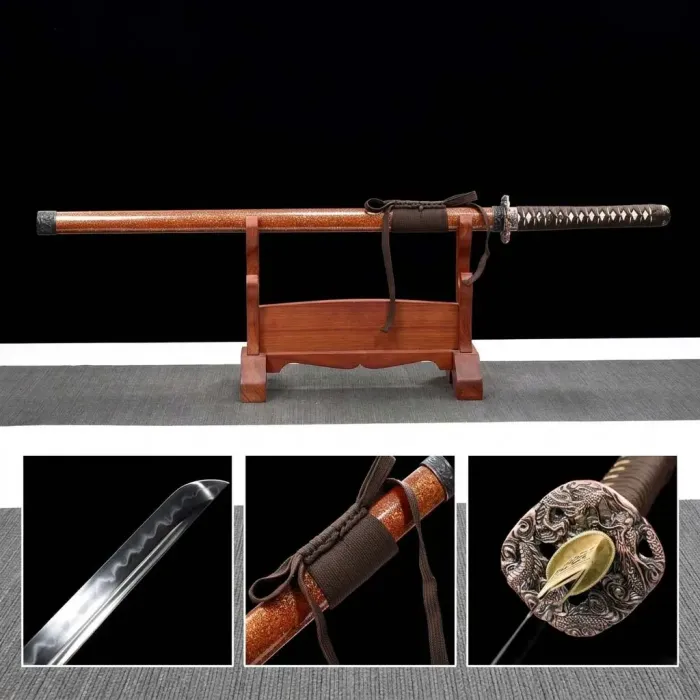
While the finished sword is undeniably the central point of a katana, truly heightening its appeal lies in the meticulous customization of its features and shaft . This practice allows devotees to communicate their personal approach . Reflect on the vast possibilities: menuki - decorative ornaments that enhance visual beauty ; the hamon wrappings – often elaborately molded ; the tsuka basis itself, wrapped in authentic ito binding ; and the fusa butt cap , which can be fabricated from various substances like treasures or antler .
- Adopt styles that match with you.
- Investigate with various components .
- Accent craftsmanship for a continuing impression .
The Magnetism of the Katana: Background, Fabrication, and Iron
Every nihonto exhibits a unique allure, steeped in generations of Asian history and tradition . More than merely a implement of military action , it's a figure of the warrior ethos – a fusion of expertise and management . Its unfolding spanned numerous generations, with early cutting instruments evolving into the sleek-lined curvature and effective edge we acknowledge today. The fabrication involved is truly phenomenal , requiring eons of apprenticeship to perfect . The process involves a detailed folding of smelted iron , creating layers that fortify the instrument’s flexibility and slicing ability. Diverse schools of crafting appeared , each with their special secrets and formulas for achieving the ideal equilibrium and edge - a truly demanding pursuit.
- Primary Katana varieties
- The part of the cutting armament in knight culture
- Conventional manufacturing procedures
Determining the Right Steel for Your Armament Project: 1060 vs. T10
Determining the favorable steel is essentially important for any oriental blade project, and the resolution between 1060 and T10 can be delicate. 1060 is a regular American fabrication, offering a fair balance of resilience and hardiness, rendering it quite easy to temper. However, T10, a originating from Japan steel, generally boasts exceptional wear permanence and can probably achieve a enhanced conclusive hardness, although it can be markedly troublesome to work with and requires refined heat modifying. Consider your competency and projected results: for a trainee, 1060 may be a safer launchpad, while the proficient smith might favor the increased traits of T10.
- Facility of Processing
- Edge
- Terminal Tenacity
Accessing Excellence: Progressive Katana Alteration Approaches
Honing the expertise in edge enhancement extends far beyond basic stropping. Serious masters are now investigating advanced techniques to truly expose a blade's hidden potential. This features intricate work with the temper line, utilizing specialized resources for differential heat treatment and carefully selecting the contour of the hand guard to optimize balance and functionality. Beyond purely functional changes, artisans are increasingly focused on realizing unparalleled aesthetic style, through complex etching and layered films that truly transform a katana into a masterpiece.
Transforming Basic Steel into Art: Building a 1060 Sword
The journey initiates with common 1060 material , a tough material far separated the refined katana it will change . Talented bladesmiths apply a detailed process of combining and swords katana forming the crude steel, repeatedly burning it and flattening it to extract impurities and establish a consistent grain structure. This exhausting process, often going on for weeks , builds the crucial solidity and give characteristic of a legitimate Japanese tool. Additional heat applications , including careful hardening and annealing , are necessary to achieve the aimed balance of sharpness, life and charm .- Overlaying: Reduces impurities and forms grain structure.
- Hammering: Creates the steel into the initial blade form.
- Cooling: Sets the final hardness and flexibility.
The Everlasting Fascination of the Katana: Broad Investigation of Metalcraft and Adjustment
The classic katana endures a potent symbol embodying Japanese custom , its enticement far beating mere weaponry . Forged from a special steel and sometimes featuring intricate motifs , the practice of creation itself is a esteemed art. Beyond the crucial craftsmanship, the ability to adapt a katana - from the edge marking to the shaft wrapping and fastening - provides for a honestly individual demonstration for both worshippers and participants alike. This confluence of classical steelwork and boundless personalization creates the katana's continued widespread acceptance across the universe.